Field Guide / FIELD READING
The stages between paddy and a bowl of rice
Husks, bran, broken kernels and batch records explain why rice changes after the field.
Growing guide · 3 min read Crop & CanopyA life in growing
Follow the grain from its place on the panicle through husking, milling and the forms that reach a kitchen.
Meet the growing crop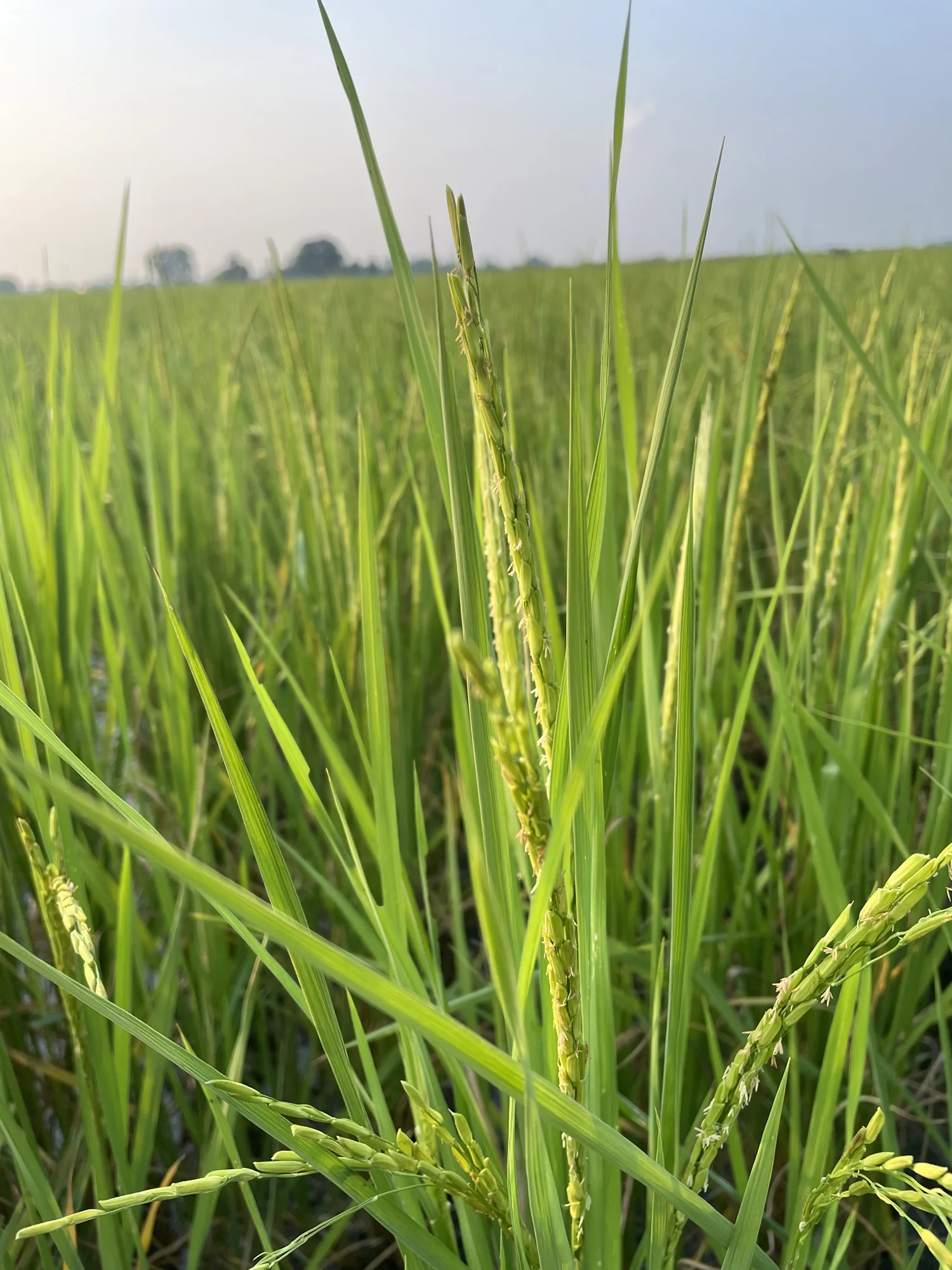
Inside a rice panicle, each developing grain fills beneath a close-fitting husk. That covering stays with the grain when it leaves the plant as paddy. What happens next determines the form we recognise in a kitchen: remove the husk and the edible kernel appears; remove more of its outer layers and the grain changes again. Following those layers makes familiar words such as brown rice and milled rice easier to understand.
Choose a form to see its layers and the work behind it.
Paddy, also called rough rice, is the harvested grain enclosed in its husk. Cleaning can remove loose field material without changing this basic form. The edible rice kernel is still inside.
Husking exposes the kernel while leaving its bran and germ largely intact. Brown rice describes this processing stage, rather than a single variety. The retained outer layer can also be reddish or purple in coloured rice.
White or milled rice has had the husk removed and the bran layers and much of the germ taken away by further milling. A white grain has therefore passed through a different degree of processing from brown rice.
The sequence depends on the crop and how it will be handled. These are general processing stages.
After flowering, the developing rice grain fills within its husk. Ripening takes the grain towards maturity; a panicle can contain grains at slightly different stages. The crop’s appearance and the condition of its grains together inform the harvest decision.
Harvest removes the crop from the field. Threshing separates paddy grains from the panicle and straw. A combine can bring cutting and threshing into one operation, but the husk still surrounds the grain that comes out.
Cleaning removes pieces of straw and other foreign material. Drying reduces grain moisture for the next handling or storage stage. Neither operation removes the close-fitting husk, and drying needs to be even enough to protect grain quality.
A husker opens and removes the outer hull. Beneath it is the rice kernel with its bran layers still present: brown rice. The loose husk is a separate material; it is not the bran that remains on the kernel.
To make white rice, further milling removes bran layers and much of the germ, leaving mainly the starchy endosperm. The degree of milling describes how much has been removed. This is a processing choice, separate from the variety’s name.
Some kernels break during handling and milling. Grading can separate those pieces from the longer, intact kernels. A finished lot may include a stated proportion of broken rice; the form and grade help describe the ingredient that reaches the kitchen.
Seven sacks of paddy at 30 kg each made a 210 kg harvest. About 70 kg was kept as paddy, leaving approximately 140 kg for processing into rice. These figures describe how the paddy was divided.
The retained and processing quantities are two portions of the harvest. They do not give the weight of rice returned from the mill or establish a milling recovery.
Brown rice describes rice after the husk has been removed while bran remains. Many varieties can be processed this way. Ask for both the variety name and the milling description when choosing a lot.
Broken kernels are pieces separated during grading, rather than a variety of their own. Ask whether a quoted quantity includes both whole and broken kernels; a whole-kernel weight alone does not describe every rice fraction returned.
Parboiling uses moisture and heat while the grain is still in its hull, before later processing. It is a separate choice from how much bran is removed. A variety name alone does not tell you whether rice was parboiled.
Husks, bran, broken kernels and batch records explain why rice changes after the field.
Growing guide · 3 min readTillers, flowering and filling grain: the changes to look for as rice develops.
Growing guide · 1 min readRice harvested, mustard sown, and banana care continuing: October brings several seasons of work together.
Farm story · 1 min readIllustrations explain the processing stages in general. Photographs come from our farm archive; they do not represent each illustrated food form or the weighed batch.