Feeding the soil, feeding the leaves
Basal feeding, top-dressing and foliar sprays, explained through a season in the banana and paddy fields.
In this guide
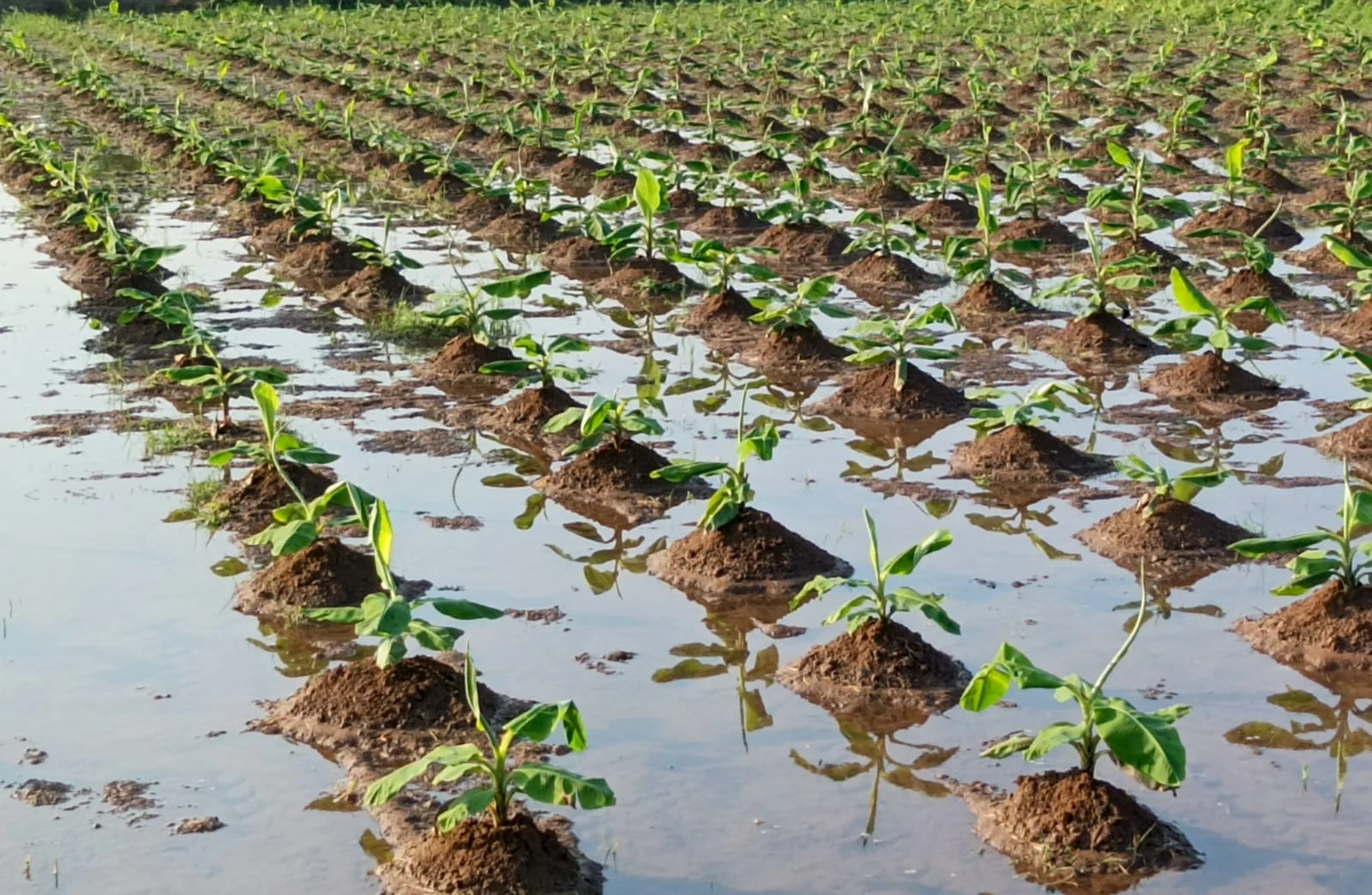
Wet ground held up the banana soil-feeding round in September. Foliar feeding continued in the meantime; the first soil top-dressing came later, followed by rain that replaced a planned irrigation. The sequence puts several often-confused feeding terms into an actual season.
Different ways of supplying nutrients
Basal feeding supplies nutrients at establishment. Top-dressing adds fertiliser to the soil while the crop is growing. Foliar feeding applies a suitable nutrient solution to the leaves. Fertigation is a fourth route: nutrients delivered through an irrigation system. These are different methods, with different placement and product requirements. [1]
Our archive records both soil feeding and foliar rounds in banana. It does not establish that this plantation used fertigation.
When the soil kept us waiting
On 7 September 2026, the banana ground was still saturated and soil feeding was deferred. Weed clearing continued, with foliar feeding recorded in the meantime. The first soil top-dressing began on 19 September and was reported complete on 22 September.
Irrigation was the next planned task. By 24 September, rain had supplied enough moisture to make that irrigation unnecessary. The next operation changed because the field had changed.
The rain had changed the next job. Fertiliser application alone could not tell us whether more water was still needed.
Why a crop may be fed in rounds
TNAU describes split nutrient applications for banana, with timing related to growth. Its schedules vary with cultivar and production system; the general idea is to match supply to demand through the crop's life. The published regional quantities are not a ready-made plan for this farm. [1]
Our second banana top-dressing began in October and was confirmed complete, together with earthing-up, on 18 October. Irrigation was still ongoing. Those are three connected operations, with three separately recorded statuses.
Paddy had its own timetable. The archive records nutrient work progressing by variety before seasonal fertilisation was marked complete on 30 September. One variety's finished round did not close every other field's work.
What a foliar grade leaves unsaid
The banana notes include 12:61:0 and 19:19:19 foliar rounds. Their grades describe nutrients, but not a complete spray specification. Product formulation, concentration, water volume, coverage and crop condition also belong in that decision. A soil dose cannot simply be moved into a spray tank. [1]
Some later entries mention nutrient and crop-protection products together, with changes between the planned and reported mix. We keep that history without treating it as a tested tank-mix recommendation. Compatibility must be established for the exact products. [2]
Looking after the application
Fresh growth, persistent symptoms and rain after application all belong to the later part of a feeding round. Returning to the same plants helps show those changes. A better-looking leaf still cannot reveal, without a comparison, how much improvement came from the input.
The sequence—from wet ground to application to the crop afterwards—is what makes the round worth returning to next season.
About this story
Chronology comes from the farm archive for 7–24 September, 30 September and 18 October 2026. The archive contains completed, ongoing and planned tasks. No trial has isolated the effect of an individual feeding round.
From the farm’s dated working notes.Sources & further reading
- TNAU · Banana nutrient management Accessed 2026-10-23
- Department of Agriculture, Meghalaya · Pesticide handling Accessed 2026-10-23